Transmission 010 // "Carthis”

The next day, the world carried on as it always did. Lessons drifted past in a blur. The teacher’s voices sounded distant and muffled, as if they were trapped behind glass. Pens scraped. Chairs shifted. Nothing had changed, but somehow everything had.
Amelia stood outside the school gates, her bag slung over her shoulder. Students swarmed past—laughing, jostling, shouting like it was just another Tuesday. For them, it was.
Marv appeared beside her without a word. Just a glance. A nod.
That was enough.
They walked. The street hummed—traffic lights blinked, people drifted between shops. The play of life went on around them, each role playing out automatically, as if the world were running on muscle memory.
As they waited for the bus, Marv spoke.
“You sleep?”
Amelia shook her head. “Not really. You?”
He shrugged. “Eventually.”
The hush returned as they boarded and took their seats.
Outside the window, Willowbrook’s neatness began to unravel. Modern concrete and brick became cracked gray sandstone. Taut power lines began to sag like tired shoelaces. Even the road seemed to come undone, smooth tarmac under the tires turned into the constant rumble of old cobbles.
The morning’s rain lingered around the edges of everything. It clung to roof tiles, pooled in potholes, and dripped from window sills. The smell of damp and salt was everywhere. And, as the bus rolled deeper into Old Town, the city seemed to rewind itself.
Once, this had been Greenhaven’s heartbeat. Trade had surged through Old Town’s veins like a whisky-warmed current—dark, heady, and intoxicating. Ships pressed tightly along the docks, their masts a forest against the sky. Sailors and strangers poured into the countless bars and bathhouses at all hours of the day and night. Crates of silks and spices stacked high in markets that never seemed to sleep.
But all tides must turn eventually. Modern container ships became behemoths—too vast for Old Town’s aging docks, and crewed by only a handful of men. The arrivals dwindled, and with them the noise, the colour, the pulse. Industry gradually drifted inland—timber giving way to technology, muscle to microchips. The markets and weigh houses stood empty. Windows shuttered. Doors chained. And now, Old Town’s buildings stood adrift, like the rusted hulls of ships long forgotten, stranded in the shallows of a different time.
The bus hissed to a stop. Amelia and Marv stepped down onto damp cobblestones.
Olemental Square stretched out before them—a quiet plaza nestled between Old Town’s slow unraveling and Midtown’s polite restraint. It felt like a pause in the city, a hollow space where the streets fell back and the air shifted.
Tall plane-trees claimed the centre, their branches tangled into a canopy that fractured the sky into panes. Their leaves had begun to turn—reds, browns, the occasional flash of gold. The unmistakable palette of endings. Around the edges, a patchwork of buildings leaned inward, their shoulders pressed together as if conspiring to keep the square secret. Ivy threaded up their walls, patient and unhurried, clawing at window frames as though testing for weakness.
Near the roots of one tree stood an oversized chessboard, the black squares weathered to grey by the elements. Most of the pieces still stood mid-game, though a bishop had tipped, and the white queen was nowhere to be found. Old tramlines snaked out from underneath the board, cutting through the cobbles toward a station that no longer existed. Amelia’s eyes followed the tracks until they passed by the fountain crouched at the square’s heart. Moss freckled its basin and leaves choked its mouth. It hadn’t run in years. And yet—sometimes—she swore she could hear it. A trickle of water, hidden deep below.
On the far side of the square was an outdoor cafe area. Metal chairs sat where they’d been left. A broken parasol lay on its side, its fabric flapping in the breeze like torn sails. The hut beside it had graffiti across its metal shutters. At first glance it looked like a lion, but the longer Amelia stared, the less certain she became. Underneath, a ragged flyer hung stubbornly. All she could make out was the shape of a saxophone—a local jazz night, maybe. Its music long gone.
Amelia glanced at Marv, then flicked her eyes forward.
A sudden flutter cut across her vision—pigeons bursting upward, scattering from something unseen. The rush of air grazed her cheek, gone as quickly as it came. They wheeled, circled, then dropped back to the cobbles, resuming their endless quarrel over crumbs.
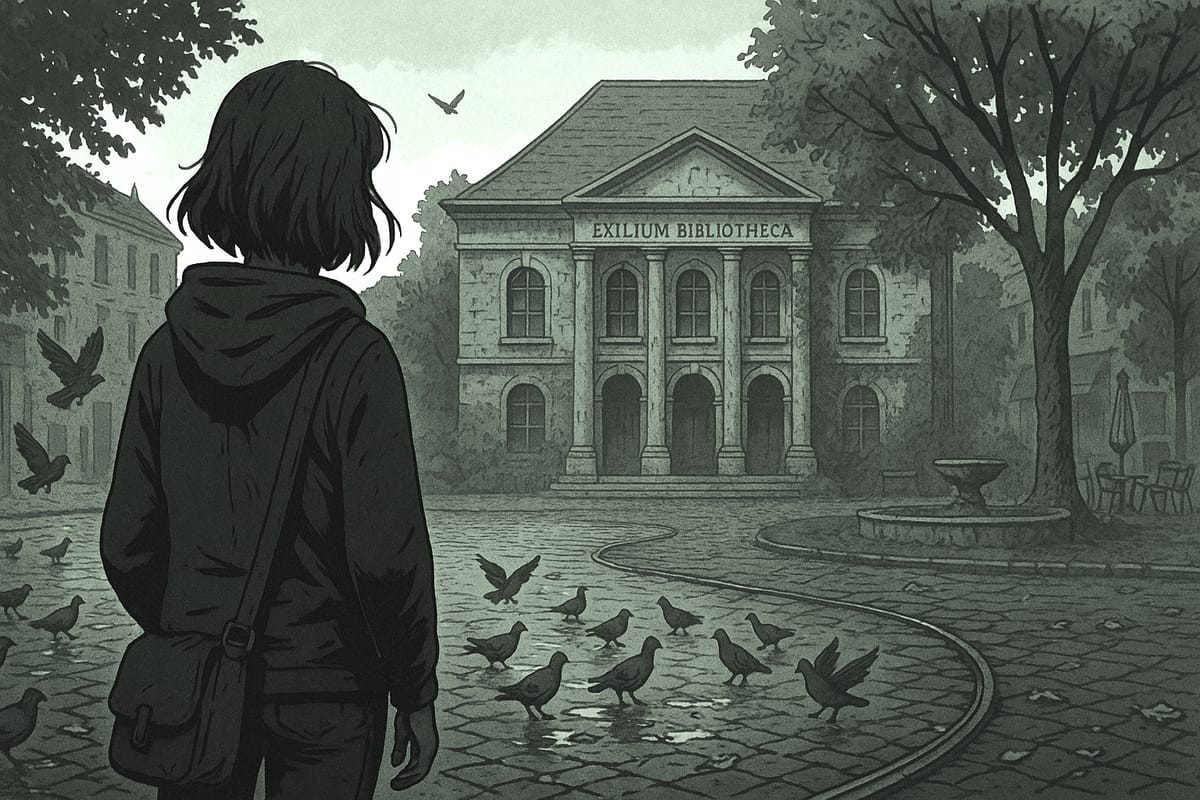
As the flurry of wings settled, she saw it. At the far end of the square, the Exilium Library waited.
Its stone was the colour of old parchment, streaked by rain and worn smooth where the years had pressed against it. At the front, a row of arches rested on weathered pillars. Behind them, the library rose broad and steady, its high windows dulled by dust yet catching seams of light as though reluctant to let go. Above, the roof pitched steeply, its ridge hooked over the arches like a shadowed crown. It had a kind of gravity without grandeur. Once, perhaps, it had been the pride of the city. Now, it simply endured—a quiet relic, half-veiled by trees, half-forgotten by the city that had grown up around it. Most people walked past without ever really seeing it.
But Amelia saw it.
And as she stood there, breath held, she could almost believe the library saw her too.
They crossed the square in silence and climbed the worn steps, two at a time. The building leaned over them, peering down as though weighing each soul that passed beneath its gaze. On either side of the heavy oak doors, two stone owls kept watch. Perched on pedestals carved into the wall, wings folded, an ornate key gripped tight in each pair of talons. Their gaze pressed outward, steady and unblinking. Guardians of sacred knowledge.
Above the doors, tarnished brass letters still clung to the stone:
EXILIUM BIBLIOTHECA
And carved beneath:
In exilio, lux et veritas manent.
In exile, light and truth endure.
They took a door each, pushing hard. The heavy wooden panels groaned inward. As she stepped across the threshold, Amelia felt the outside world fall away.
The Exilium had been founded as a refuge—for scholars, poets, and philosophers whose ideas were deemed dangerous in turbulent times past. Their spirit was woven into the fabric of the building, just as their words were scattered through the shelves. At times, Amelia swore she could feel them at her shoulder, silent and watchful, close enough to breathe down her neck. She told herself it was only a draught creeping under the oak doors. But she was never quite sure.
Over by the front desk, Raymond was speaking with a red-haired librarian. He didn’t look up as they slipped into the main chamber.
The library opened around them in quiet majesty. Row upon row of shelves climbed toward the high ceiling, dark wood rising like columns in a cathedral. Light slanted through tall windows and fractured against the stacks. Every sound seemed magnified: the scratch of a pen, a muted cough, the slow squeak of a cart’s wheel pushed by a passing volunteer.
Amelia led the way to their usual corner, a forgotten nook tucked between World History and Psychology. The shelves pressed close there. It had the feel of a conspirator’s alcove, perfect for the afternoon’s mission. The air smelled of old paper and beeswax. For a moment, Amelia let herself sink into it—pretending this was nothing more than a study session, an ordinary afternoon.
She set her bag down on the scuffed wooden table. Its surface was a map: deep scratches, faded ink blots, and carved initials. A permanent record of the visitors who had passed through. The chair protested as she pulled it out, its creak sharp and intrusive in the silence. She winced, then lowered herself carefully, as if the noise might wake the ghosts in the walls.
Across from her, Marv dropped into his seat casually, his rucksack thudding against the floor. He drew out his tablet; Amelia opened her laptop.
“Right. You ready? Let’s see what we can find.”
Marv nodded, his fingers tense over the tablet’s screen—coiled, like a sprinter waiting for the crack of the gun.
“Alright, Helpmann,” she breathed. “Let’s see who you really are.”
They picked up where they’d left off the night before: news archives, directories, profiles. Piece by piece, a figure emerged—distinguished, immaculate, and maddeningly opaque.
Richard Helpmann was born into wealth, and was educated at one of the world’s most prestigious universities. After that, he rose through the ranks of diplomacy with clinical precision. His record glittered with accolades: flawless negotiations, political victories, a knighthood for services to Anglo-Commonwealth relations. He played tennis. Piloted light aircraft. Donated generously to charities and the arts.
On paper, he seemed more myth than man: principled, pragmatic, admired on both sides of the aisle. A builder of bridges. A guardian of stability.
And the deeper they dug, the more perfect he became.
Too perfect, Amelia thought. Nobody’s this clean.
She pushed back her chair and stood, leaning her weight against it.
“Didn’t anyone ever say anything bad about him?” she huffed, half to herself. “He can’t be a real politician if he hasn’t ruffled some feathers.”
Marv leaned back as another webpage blinked onto the screen.
“You’re right. He’s either in the wrong job… or he’s blackmailing everyone he’s ever met.” The words were dry, but unease threaded beneath them. “Either way, this guy is way too good to be true.”
Before Amelia could respond, a familiar voice cut in from behind her.
“Good afternoon, you two. What are you up to?”
Raymond stood at the edge of the nook, a stack of books balanced in his arms. His gaze moved between them, eyes glinting with quiet curiosity.
“Nothing exciting,” Amelia stammered. “Just… a project. For school. Yes, a school project. Isn’t that right, Marv?”
She shot him a look, pleading for backup.
Marv didn’t move a muscle. He just sat there with a blank smile, hoping his stillness might render him uninteresting, like a park ranger stumbling on a freshly de-hibernated bear.
Raymond’s gaze lingered on him intently for a long moment.
When no words materialized, he turned his attention back to Amelia.
“And which subject are you wrestling with?… The elegant precision of mathematics? The vast expanses of geography? Or, perhaps, the alchemical mysteries of the periodic table?
“History,” Amelia said, too quickly. “We’re researching… a historical figure.”
“Ah, history,” he repeated warmly, savoring the word. “The richest subject of all. And who, pray tell, is the fortunate soul under your microscope?”
Amelia’s fingers clenched harder against the back of the chair.
“Oh, you probably wouldn’t know him. He’s… obscure.”
Raymond held her gaze for a long moment. Then nodded, just once.
“Indeed. Well… it’s been said that it’s the lesser-known figures that often leave the deepest marks on the world. That should make for a fascinating hunt.”
Amelia swallowed, forcing a smile.
“Yes. Right. Fascinating… Thanks, Raymond.”
“Very well. I’ll leave you to it.” He shifted the books in his arms. “And, Amelia, do stop by the chess tables before you leave. We’re overdue our next game.”
Raymond turned and walked away, his footsteps folding into the chamber’s hush.
Amelia let out a long sigh and looked over to Marv.
He arched an eyebrow. “Close call. You think Raymond’s got radar?”
“Yeah. That wouldn’t surprise me.”
She puffed her cheeks and sat back down.
“Let’s get back to it, Marv.”
Marv nodded, as he picked up his tablet again.
The dark roof beams looked down solemnly, four centuries of secrets etched into their grain. As the afternoon wore on, shadows stretched across them. And, in that quiet corner, beneath the long watch of history, they pressed on deeper into the hunt.
* * *
The sun had dropped low, its last light slanting through the high windows near the ceiling. Dust motes stirred in the glow, drifting like weightless ballerinas above their heads. A chill slipped through cracks in the old stone, snaked between shelves, and brushed against Amelia’s arms—a delicate whisper that raised her skin.
They had searched relentlessly—pages, directories, archives—every trace of Richard Helpmann they could find. But nothing stood out. There wasn’t a single blemish on his record. No contradictions. No cracks in the mask. Just a flawless climb to the summit of the mountain, followed by a view that felt so perfectly staged, it might just be a illusion.
Marv tipped back in his chair with a groan.
“I think my eyes need an enema,” he muttered, dragging both hands down his face. Then he squinted at her through his fingers. “We might need to call it a day, Ames.”
Amelia nodded and snapped the laptop shut. Her gaze drifted across the library to the chess tables, where Raymond sat opposite a boy she recognised from school. He sagged in his chair, shoulders collapsed, staring helplessly at the board, trying to make sense of his downfall.
She knew the feeling well.
Raymond, composed as ever, began resetting the pieces with weathered hands, restoring order one square at a time. His opponent gave a stiff nod, gathered his things, and sloped away.
Marv nudged her elbow.
“Go on, Ames. The Great Raymondo’s ready for his next trick… and he needs a volunteer to be sawn in half.”
He swung his bag over one shoulder.
“I gotta catch the bus anyway. If I’m late, Mom’ll kill me. She’s making that lentil thing she insists is my favourite.” He rolled his eyes, then grinned.
“Catch you later.”
“Yeah,” Amelia said, still watching the board. “See you tomorrow, Marv.”
She pushed back her chair and crossed the parquet floor.
“Just one game,” she said, lowering herself into the seat opposite Raymond. “Then I have to head home for dinner.”
A smile tugged at his lips.
“Ah, a single game. All or nothing. The best kind of contest.”
As he finished arranging the pieces, something brushed against her leg—soft, supple, insistent. She glanced down.
Wellington. He wound lazily between her ankles, silver-grey fur catching the last of the light, amber eyes blinking up with the regal indifference only a cat could muster.
“Hello, Welly.” She bent to scratch beneath his chin. The rumble of his purr spilled into her palm, loosening the knot in her chest. Then, with a flick of his tail, he padded away. Raymond offered him a brief tickle behind the ears before the cat slipped back into shadow.
“Excellent timing, as always, old chap,” Raymond remarked.
He turned his attention back to the table. The board was set, and the game began.
Raymond opened with unusual aggression. Both knights sprang forward, their curved paths slicing straight toward the centre of the board. Pressure came fast, forcing Amelia to defend before she’d even found her footing.
She tried to focus, to sink into the rhythm of the game, but her mind kept slipping. It circled back to the photograph, to Helpmann’s name scribbled in code, to the blank space where her parents—and all the answers—should have been.
Raymond’s voice carried across the board, carving into her thoughts.
“You know,” he said, nudging a piece into place, “This game reminds me of the Siege of Carthis.”
Amelia blinked, dragged back to the present. “The what?”
“The Siege of Carthis. The defining moment of the Second Carthanite Uprising, two thousand years ago. Carthis—the jewel of the western provinces—had risen against the Republic of Aurion, throwing its lot in with rebel states that refused to bend the knee to the invading emperor. For the rebels, Carthis was everything. If it fell, the others would follow. If it held, the spark of rebellion could become a blaze.”
Amelia shifted a knight.
“The Carthanite commander was General Mahrucan,” Raymond continued. “Still young, but already a legend. A thorn in the emperor’s side. His enemies feared him. His people adored him.”
He studied the board, eyes weighing his next move.
“The Aurion army outnumbered the Carthanites four-to-one. So, instead of meeting them in open battle at the city gates, Mahrucan led his forces to a narrow pass, three days’ ride from Carthis. There, they waited near a fortified mountain outpost, where his men could store weapons and supplies.”
He eased a pawn forward, almost casually.
“They met the enemy in the first weeks of Autumn. The battle raged for several days. The emperor’s forces took many casualties, but so did Mahrucan’s army. It was bloody and merciless. A war of attrition.”
Amelia toyed with a knight, considering where it could land—only half-listening.
“Deep into the fifth day of fighting, Mahrucan gave the order to retreat to the outpost. The enemy thought they were winning… until the battlefield emptied, and the gates slammed shut.”
Raymond’s eyes flickered behind his glasses.
“Mahrucan knew they could regroup there and tend to the wounded. The outpost was elevated, with high walls and iron gates. It had never been breached. The enemy surrounded them, but were afraid to attack. So, instead, they waited. They made camp.”
He slid a bishop along its diagonal, the piece cutting quietly across the board like a blade drawn in silence.
“Days passed. Then weeks. The Emperor had no answer. Mahrucan’s journals tell of the air cooling, of leaves falling onto the bodies of the dead outside the walls. Still, he was certain victory would come—it was only a matter of patience. Inside, his wounded men were healing. The others sang around the campfires at night, taunting the enemy troops beyond the gates.”
Amelia slid a bishop into place, shoring up her defenses. Her formation was tight, the pieces locked together. Whatever Raymond was planning, she was ready.
“Mahrucan could see the enemy growing complacent. He knew that, if they just dug in, the moment would come—and then they would strike.”
He shifted his queen along the rank.
Amelia’s hand hovered over her pieces. She frowned.
Where’s the attack coming from? What’s he waiting for?
She couldn’t see his angle, so she played safe. She castled her king, tucking him into the corner, where he would be well guarded.
Raymond answered at once, sliding a knight into place, as if he knew what she would do and had already planned for it.
Amelia narrowed her eyes.
She countered with her own knight, bracing her defenses. Solid. Safe.
Raymond replied again. Sure and certain.
She nudged a pawn forward—one of the only safe moves left to her.
His response came without hesitation. Another door closed.
She scanned the board.
Wait…
Her king was well-guarded behind a stoic line of pawns. But the knight she’d repositioned was now trapped in place, every possible landing spot overlooked. The bishop behind it was boxed in too. Her queen had options, but each route looked fraught with danger; she suspected they all led to eventual capture.
The realization slid in, cold and certain.
I can’t move without giving something up.
Raymond tapped a finger absentmindedly on the table
She could see it now. Checkmate was only a matter of time.
“For nearly two months, the defenders held the outpost,” Raymond continued.
He flicked his eyes up at her.
“Until the food and water ran out .”
Amelia’s vision blurred as she stared down at the board.
“Finally, when no other options remained, the men who hadn’t succumbed to disease or dehydration made the only move that they had left.”
His finger brushed the carved crown of his king.
“They opened the gate…
To a man, they were slaughtered where they stood.”
The silence was absolute. Their eyes met in the middle of the board.
“Mahrucan’s journal shows that, as the weeks dragged on, he began to wonder: why had the emperor sent no reinforcements? No catapults? No ladders?” Raymond’s tone thinned, each question cutting sharper than the last.
“Near the end, it seems he understood. The Emperor had sent more troops. But they marched straight past the outpost. To Carthis. The city had already fallen. It was lost.”
He gave the faintest shrug.
“Still… history remembers Mahrucan and his rebels fondly. Extraordinary examples of fortitude, discipline and bravery against impossible odds.”
Amelia pressed her fingertips to her temples.
“That doesn’t sound like much consolation.”
Her eyes dragged across the pieces, searching for an escape she already knew wasn’t there.
She looked. And looked again.
“Amelia.”
Raymond’s voice cut through the fog.
“Your move.”
Her breath slowed. Fingers hovered above her king.
The moment stretched, as thin as glass.
Then, she tipped it over.
The game finished. But her mind remained in two places—half on Raymond’s words, and half on the looming shadow of Sir Richard Helpmann.